
What is EUDI Wallet Interoperability and Why is it Important?
The market opinion on the European Digital Identity (EUDI) Wallet's interoperability is sharply divided.
On one side, some express skepticism that seamless interaction with all wallets will ever be possible.
On the other hand, a more common view is dangerously simplistic:
"There’s a common standard, so we’ll just integrate it, and we’re done."
The truth, as is often the case, lies somewhere in between. The challenge of interoperability is real, complex, and continuous. Underestimating it represents a significant business and compliance risk for any organization mandated to accept EUDI Wallets.
At Lissi, we dedicate significant resources to this task, because we understand that achieving and maintaining true interoperability is a foundational requirement for the success of the entire ecosystem. This article provides a realistic, expert-led look at the challenge and a practical path forward for organizations.
In the EUDI Wallet ecosystem, interoperability is the promise that any certified wallet, regardless of which Member State or private company issued it, can be used to interact with any service across the EU. This is the principle that enables a truly open ecosystem where tools from different providers can be used to access digital services, and it empowers users with the freedom to switch between wallet providers.
The foundation for this is the EUDI Wallet Architecture and Reference Framework (ARF).
However, while all wallets follow the same standards, the standards themselves are intentionally flexible to foster innovation. They contain numerous options and can be interpreted differently, leading to varied implementations among wallet providers. The standards offer a wide range of choices, and one wallet may implement certain parts of a specification while another implements different parts, based on national or sector-specific requirements.
This divergence is evident even within the EU's own Large-Scale Pilots, which have different requirements for their interoperability testbeds.
This creates the central challenge: being "standards-compliant" does not automatically guarantee seamless interoperability in the real world.
The Pyramid of Complexity
Achieving interoperability is not a simple task of implementing a single protocol. It is a multi-layered challenge that can be understood through a "Pyramid of Complexity," where each layer builds upon the previous:
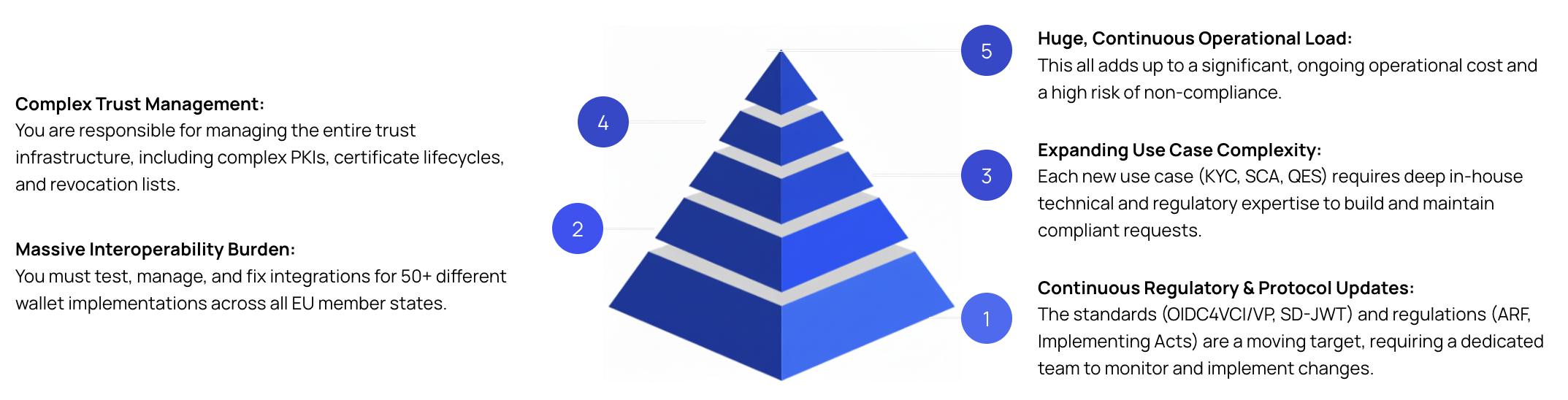
Layer 1: Foundational Protocols & Security Profiles:
The technical bedrock is not just one standard, but a complex web of interdependent components for issuance (OpenID4VCI), presentation (OpenID4VP), data formats (SD-JWT, mdoc), revocation, and trust mechanisms. Crucially, simply "speaking" these protocols are insufficient. To ensure high interoperability and security, the ecosystem is adopting strict profiles like the High Assurance Interoperability Profile (HAIP). HAIP restricts the countless optional features of standard protocols to a secure subset—mandating specific cryptographic curves or methods for holder binding. If your implementation supports generic OpenID4VP but fails to strictly adhere to HAIP, you will effectively be locked out of interacting with certified wallets.
Layer 2: Wallet Implementations & Data Semantics:
Organizations must prepare to interact with 27+ different wallet implementations. Beyond the sheer number of endpoints, a major hurdle is "Semantic Interoperability" and data normalization. Different wallets may technically deliver the requested attribute (e.g., "Date of Birth") but in varied formats—one sending DD.MM.YYYY and another YYYY-MM-DD. To your backend systems, these cause unexpected failures. True interoperability requires a dynamic translation layer that normalizes this chaotic input into a clean, consistent format your internal systems can process.
Layer 3: Expanding Use Cases & Complex Query Logic:
A simple PID verification for KYC has different requirements than a multi-credential request to authorise a payment using a strong customer authentication or a Qualified Electronic Signature (QES). As use cases grow more sophisticated, so does the complexity of requesting data. You may need to request a PID and (a University Degree OR a Professional Certificate). Standard protocols struggle to express this logic efficiently, which is why the ecosystem is using the Digital Credential Query Language (DCQL). DCQL allows Verifiers to write structured, flexible queries to request credentials selectively. The complexity on this layer is for the verifier defining and maintaining these queries and ensuring they meet the needs for their use case.
Layer 4: Diverse Trust Frameworks & National Rules:
The ecosystem relies on a complex web of trust, including different PKI models and trusted lists. Organizations must validate credentials against varying national rules and trust mechanisms. This isn't just about technical verification; it involves real-time lookups against National Trust Lists (LOTL) which change as issuers are accredited or revoked.
Layer 5: Continuous Ecosystem Evolution:
The ARF, Implementing Acts, and technical standards are not static; they will continuously evolve. Interoperability is not a one-time project but an ongoing commitment to adaptation. Furthermore, a successful user adoption is critically dependent on a great user experience, and details like landing pages, callback URLs, or user-friendly integration of the Digital Credential API are often overlooked.
The Lissi Method: A Systematic Approach to Interoperability
At Lissi, we believe that navigating this complexity requires deep, sustained immersion in the ecosystem. This is a field with a steep learning curve, where true expertise is held by a handful of specialists who have spent years helping to create the standards themselves—like our team.
Our systematic approach is built on active participation and rigorous testing:
- We directly participate in interoperability demonstrations held by standardization organizations like the OpenID Foundation or events by the European Commission such as the EUDI Wallet Launchpad event in Brussels.
- We are active contributors to all major EU Large-Scale Pilots, including EWC, POTENTIAL, DC4EU, and now WE BUILD, allowing us to test our software against a wide range of implementations before they become public.
- We are a winner of the German Wallet Challenge, ensuring close alignment and continuous testing with the official German wallet team.
Automating the Plumbing, Configuring the Policy
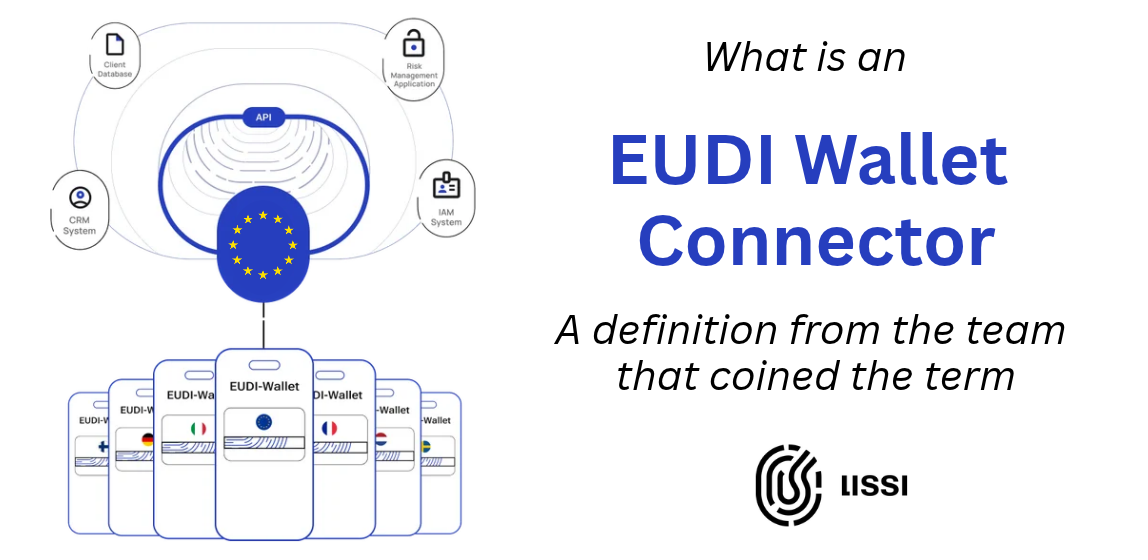
Facing the pyramid above, organizations face a stark "make vs. buy" decision. Building in-house means committing to a complex technical integration project involving multiple departments. At Lissi, we solve this by strictly separating the automated technical checks from the business configurations.
Our connector automates the heavy lifting of the "plumbing" - handling the cryptographic verification of issuer signatures, checking presentation integrity, enforcing HAIP security profiles, parsing complex DCQL queries, and performing the essential semantic normalization of attribute data among others. This allows your team to focus purely on "policy" configuration: e.g. by defining which attributes you need (e.g., "User over 18"), which Trust Anchors you accept (e.g., "Credentials from Germany and France"), or what level of holder binding is required. By abstracting the technical enforcement, we ensure your developers focus on business value rather than protocol maintenance.
Current Status: The Lissi Connector Interoperability Matrix
This systematic work yields tangible results. As of today, the Lissi EUDI-Wallet Connector has undergone successful interoperability tests with over 25 different wallet prototypes from the Large-Scale Pilots and the German Wallet Challenge.
To ensure robustness, we have developed a suite of individual tests covering multiple flows for each interaction. Our testing covers the full spectrum of relevant protocols, including OpenID4VCI and OpenID4VP, as well as the primary credential formats like SD-JWT and mdoc/ISO 18013-5. This ongoing, multi-faceted testing process ensures our partners can be confident that our software is the most robust and widely compatible solution on the market.
The Road Ahead: Future Challenges & Our Commitment
The work on interoperability is never truly finished. The market as a whole must still address significant challenges, including the creation of common understandings for the semantic meaning of attribute data and further alignment on divergent national integrations for registration certificates and trust mechanisms.
Lissi is committed to solving this challenge for our clients and partners long-term. Our software provides a single integration point for certified wallets, and we contractually guarantee interoperability with all certified EUDI Wallets. This guarantee is backed by a concrete, ongoing investment:
- We have a dedicated team that constantly monitors wallet developments and engages in every available testing opportunity.
- We have written hundreds of unit and integration tests to automate our testing suite as much as possible.
- We regularly test our services against official reference implementation test suites.
- Crucially, we provide one of the most advanced wallets ourselves.
This gives us unparalleled insight into the challenges wallet providers face, allowing us to build a more robust and streamlined connector. By partnering with a specialist vendor like Lissi, organizations can effectively outsource this immense complexity, allowing them to focus on their core business while we manage the intricate and ever-evolving connections to the EUDI Wallet ecosystem.